1st-degree: people you can message directly
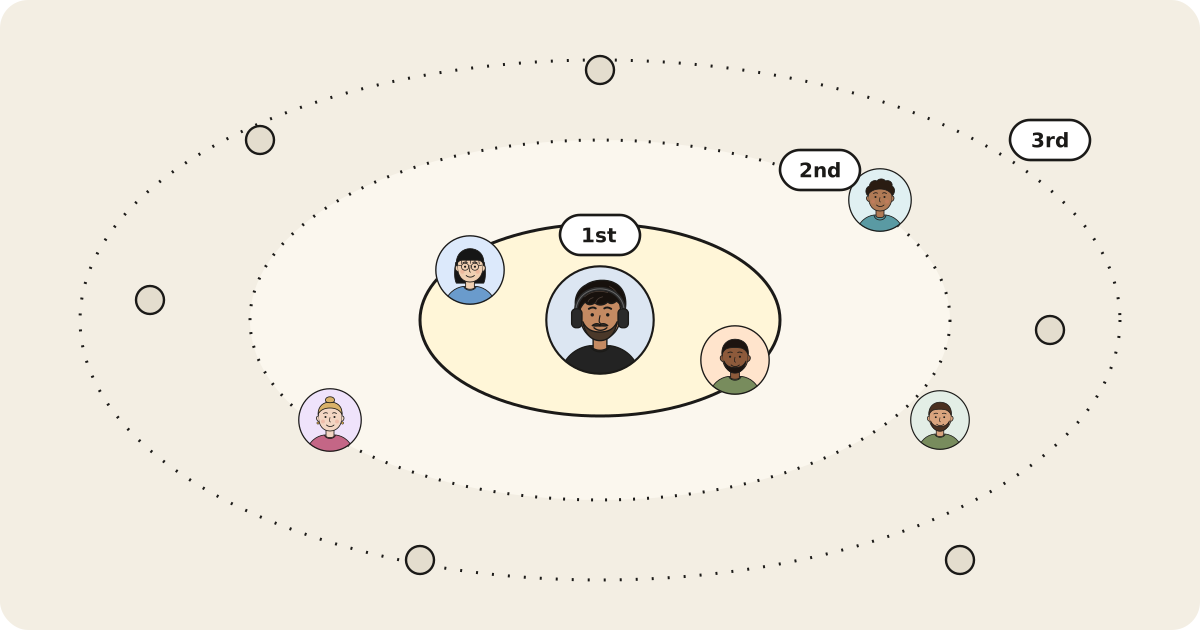
These are your direct connections, which LinkedIn defines as people you’re directly connected to. You can message them for free, and LinkedIn shows a plain "1st" badge on their profile. This is your highest-leverage group for warm intros, since you don't need anyone else's help to reach them; the only question is whether the relationship is strong enough to ask for a favor.
2nd-degree: one hop away, reachable through someone you trust
A 2nd-degree connection is connected to at least one of your 1st-degree connections. LinkedIn shows you the mutual connections on their profile, which is exactly the information you need to request a warm intro instead of sending a cold InMail. On a free account you generally can’t message a 2nd-degree connection directly: you send a connection request, or use InMail, which needs a paid plan. Going through the mutual connection is usually the better route anyway.
3rd-degree: further out, but not out of reach
3rd-degree connections are two hops away — connected to someone connected to one of your 1st-degree connections. LinkedIn doesn't always show the exact chain for 3rd-degree profiles, which makes these harder to warm-path manually. This is usually where cold outreach becomes the more practical option, unless a specific shared group or mutual connection surfaces the path.
The closest connection isn't always the most useful
A five-year experiment on more than 20 million LinkedIn users, published in Science in 2022, found that moderately weak ties did the most for job mobility. Measured by mutual connections, usefulness rose up to roughly 10 shared connections and then fell. In other words, the acquaintance you share a handful of contacts with may open more doors than your closest friend, because they move in different circles.
Why this matters for outreach strategy
| Degree | Best approach |
|---|---|
| 1st | Message directly, reference shared history |
| 2nd | Request a warm intro through the mutual connection |
| 3rd | Cold outreach, or look for shared group/school context |
Finding the right degree for your goal automatically
Manually checking degree and mutual connections for every person on a list doesn't scale. People by Sniff factors connection degree directly into its ranking, so 1st and 2nd-degree paths with strong mutual context surface above weaker or more distant matches automatically.
Sources
- LinkedIn Help: Your network and degrees of connection, messaging on LinkedIn, InMail
- Rajkumar, Saint-Jacques, Bojinov, Brynjolfsson & Aral, A causal test of the strength of weak ties (Science, 2022), and MIT IDSS summary