
I work on People by Sniff, which helps you find who in your LinkedIn network knows the person you want to meet. The templates are my own; claims about other people’s advice and research link to the original source, checked October 19, 2026.
1. Pick the connector who knows them best
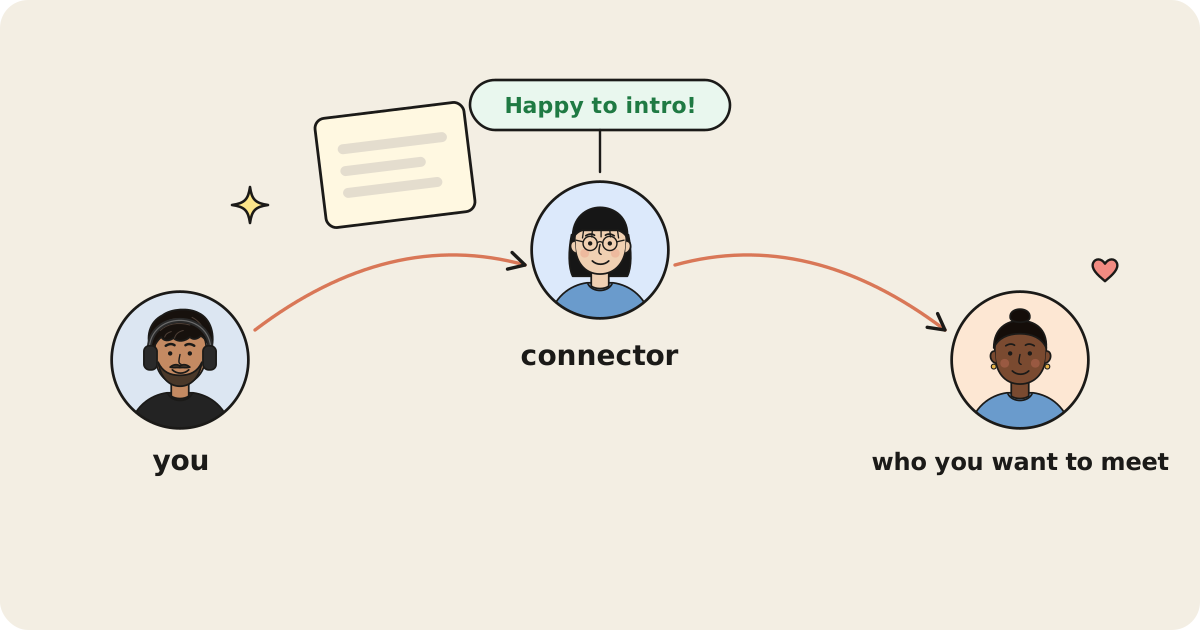
Being connected on LinkedIn is not the same as knowing someone. Plenty of connections are a conference handshake or an accepted request from 2017. An intro from that person carries almost no weight, and they’ll often say no because they don’t want to spend a favor they don’t have.
Before you ask, check how the connector and the target actually overlap:
- Shared history. Did they work at the same company at the same time, go to the same school, or sit on the same board?
- Recent contact. Have they interacted lately, on LinkedIn or anywhere else you can see?
- Your own relationship with the connector. Someone who knows you well can vouch for you; someone who barely knows you can only pass a note along.
The best connector is strong on both sides: close to you and close to the target. If several people qualify, ask the one with the most recent, most relevant overlap.
Doing this by hand means opening mutual connections one by one and guessing. This is the part People by Sniff handles: you ask something like “who can introduce me to someone at Ramp?” and get a ranked list of your connections with the reason each made the list. The ranking uses a power score that weighs relationship strength, recent activity and relevance. On Pro, it also searches your teammates’ networks and names the teammate to ask.
2. Ask first, introduce second: the double opt-in
A double opt-in intro means the connector asks the target whether they want to meet you before putting you both on a thread. The investor Fred Wilson made the case for it in 2009: surprise intros push people into meetings they don’t want or vague brush-offs, and both waste time. Asking first protects the target’s time and the connector’s reputation.
For you, it changes one thing: don’t ask your connector to “just cc me with them.” Ask whether they’d be willing to check if the person is open to it, and give them something to send.
3. Write a note they can forward as-is
The standard tool here is the forwardable email: a note written so your connector can pass it on with little or no editing. Techstars’ Alex Iskold described the format in 2015: you explain who you are and why you want the meeting, and the connector forwards it with “a sentence or two” of their own. Elad Gil’s advice on asking for intros makes the same point: make it easy to forward, and be specific about what you want.
A good forwardable note has:
- A subject line that names the target, so it’s easy to find later: “Intro to Priya Shah (Ramp)?”
- A short private note to the connector at the top: who, why them, and an easy way to say no.
- A forwardable paragraph about you and your ask, written so it makes sense to someone who has never heard of you.
- One specific ask. “Twenty minutes to ask about their onboarding work” beats “pick your brain.”
- A link to your LinkedIn profile, the job posting, or your deck, depending on the ask.
Keep the whole thing under about 150 words, and ask for one intro per email.
4. Templates for each situation
Replace everything in brackets. Each template is the full email to your connector, with the forwardable part last.
Job referral
Hi [Connector], I saw you worked with [Target] at [Company] on [team]. I’m applying for [role] there and would love 15 minutes with them about the team before I do. Would you be comfortable checking if they’re open to it? No worries at all if not. A forwardable note is below.
[Your name] is a [current role] at [company] who has spent [time] working on [relevant work]. They’re applying for [role, linked] and would value 15 minutes to hear how the team works. LinkedIn: [link].
Referrals carry real weight: in Ashby’s data on more than 38 million applications, 40% of referred applicants reached an interview, against 3% of inbound applicants. More on this in how to get a referral at any company and our job search page.
Sales
Hi [Connector], you and [Target] overlapped at [Company]. We’re talking to teams like theirs about [problem]. Would you be open to asking whether they’d take a short call? Totally fine to pass.
[Your name] runs [function] at [your company], which helps [type of team] with [outcome]. They noticed [specific, public thing about the target’s company] and would like 20 minutes to compare notes, not a pitch deck.
Be honest that it’s a sales conversation; connectors who feel tricked don’t intro twice. If you’re working a whole account list, see warm paths for sales.
Fundraising
Hi [Connector], I’m raising a [stage] round for [company] and [Investor] at [Firm] looks like a strong fit given [their relevant investment or writing]. Would you be comfortable asking if they’re open to a conversation? Happy to hear if you think it’s the wrong fit.
[Your name] is the founder of [company], which [one line on what it does]. [One line of traction]. They’re raising [amount] and thought of [Investor] because of [specific reason]. Deck: [link].
An intro to an investor reflects on whoever sends it, so choose a connector who knows the investor, not just someone with a well-known name. See how to find investors through your LinkedIn network and our fundraising page.
Hiring
Hi [Connector], I think you worked with [Candidate] at [Company]. We’re hiring a [role] and their work on [project] stood out. Before I reach out, would you be willing to ask if they’re open to a conversation? Also curious what they were like to work with, if you’re comfortable sharing.
[Your name] leads [team] at [company]. They’re hiring a [role, linked] to work on [problem] and would love a no-pressure chat with [Candidate], even if they aren’t looking right now.
Ask about the candidate as well as asking for the intro: a former colleague’s view is often worth more than the intro itself. More on hiring through your network.
5. The LinkedIn DM version
If your relationship with the connector lives on LinkedIn, ask there. On LinkedIn you can message your connections directly; people you aren’t connected to need an InMail, which requires Premium. A DM should be shorter than an email:
Hi [Connector], hope [something specific and recent] went well. Quick ask: I see you know [Target] from [shared history]. I’d love 15 minutes with them about [specific ask]. Would you be comfortable checking if they’re open to it? I can send a short blurb you can forward. Easy no if it’s not a fit.
Send the forwardable paragraph only after they say yes, so they aren’t holding something they didn’t agree to pass on.
6. Follow up, then close the loop
- One follow-up. If you hear nothing after about a week, send one short, friendly nudge. After that, let it go.
- Move fast once you’re introduced. Reply within a day, move the connector to bcc, and take scheduling off their plate.
- Thank the connector twice. Once when they make the intro, and again when something comes of it: the meeting, the offer, the deal, the check. That second note is what makes them happy to help next time.
- Look for a way to return the favor. An intro of your own, a useful link, or a share of something they posted.
7. What not to do
- Don’t ask someone who barely knows the target. A weak intro can do more harm than a good cold message. If no strong path exists, a well-researched cold message may be the better move.
- Don’t make the connector write it. If they have to explain who you are, the intro probably won’t happen.
- Don’t bundle asks. “Could you also intro me to…” turns a small favor into a chore.
- Don’t skip the opt-in. Never ask the connector to add the target to a thread without checking first.
- Don’t go around them. If they say no, don’t message the target and mention their name anyway.
- Don’t ask the same person too often. Spread asks across people, and give more than you ask for.
Sources
- Fred Wilson, The Double Opt-In Introduction (AVC, November 2009)
- Alex Iskold, Why and How You Should Write a Forwardable Introduction Email (Entrepreneur, July 2015)
- Elad Gil, How To Ask For An Introduction
- Ashby, Are referred candidates more likely to get hired? (38M+ applications, 2021–2024)
- LinkedIn Help, Send messages to connections
- All checked October 19, 2026.