
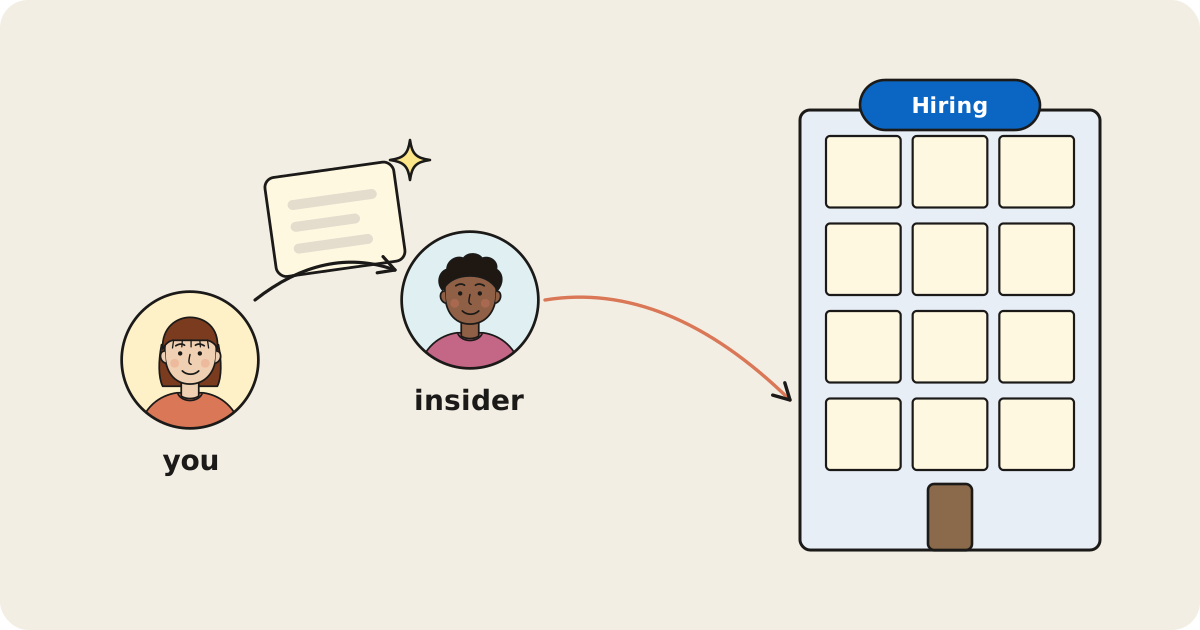
Step 1: find who's already there
Search your 1st-degree connections first for anyone currently at the target company — former colleagues, classmates, or people you've kept in touch with. This is usually your strongest referral source, since you don't need an intermediary.
Step 2: check 2nd-degree paths if no direct connection exists
If no 1st-degree connection works there, look at 2nd-degree connections and check who the mutual connection is. A referral from someone you don't know directly, obtained through a mutual connection's introduction, still counts and still helps. Referrals carry real weight in hiring: in a New York Fed study of one U.S. company, referred candidates were 6% of applicants but 21% of the people interviewed and 29% of hires. Ashby’s data on 38 million applications found 40% of referred applicants reached an interview, against 3% of inbound applicants.
Step 3: ask for the right thing
A referral ask has a much higher yes-rate when it's specific:
- Link the exact job posting, not "let me know if you hear of anything."
- State clearly whether you're asking for a formal referral submission or just advice/an intro.
- Attach your resume and a one-line summary of fit, so they don't have to do research to say yes.
- Make it easy to decline gracefully — don't put pressure on a weak connection.
Step 4: don't stop at one company at a time
If you're applying broadly, checking each target company one by one in LinkedIn search is slow. It's faster to ask the reverse question: "which companies on my list do I already have a connection at?" and prioritize applications accordingly. People by Sniff answers exactly that kind of cross-reference in one search instead of company-by-company lookups.
What to do with zero warm paths
If no connection exists anywhere close to the company, a referral isn't available — but a targeted, well-researched application referencing something specific about the team or role is still your best next option, and worth more effort than a generic application when you know a company is a genuine priority.
Sources
- Brown, Setren & Topa, Do Informal Referrals Lead to Better Matches? (Federal Reserve Bank of New York Staff Report 568; Journal of Labor Economics, 2016)
- Burks, Cowgill, Hoffman & Housman, The Value of Hiring through Employee Referrals (IZA DP 7382; Quarterly Journal of Economics, 2015)
- Ashby, Are referred candidates more likely to get hired? (2025, 38M+ applications)